Bellewstown Racecourse is proud to announce its 300th-anniversary celebration will take place during their August Festival on Tuesday and Wednesday August 25th and 26th, officially marking three centuries of rich racing heritage on the Hill of Crockafotha.
Horse racing was first recorded at Bellewstown in 1726 and has been a staple of the Irish racing calendar even since, significantly contributing to County Meath’s unparalleled legacy in thoroughbred breeding and racing, a heritage epitomised by the enduring prestige and historic prominence of Bellewstown Racecourse. The Irish National Professional Bookmakers Association (INPBA) is the official gate sponsor for the Bellewstown Racecourse 300th celebration event on Tuesday, August 25th and general admission for the race day is completely free, once patrons pre-register online at www.bellewstownraces.ie
The two-day August Festival will blend rich history with exciting new developments. To get proceedings underway on Tuesday August 25, a spectacular vintage horse-drawn carriage will parade up the home straight, paying homage to the equestrian roots that have defined Bellewstown for three centuries.
Julianstown Youth Orchestra will perform throughout racing, adding a rich, festive musical atmosphere to this historic milestone.
A commemorative plaque will be unveiled by special guest, Martin Heydon, Minister for Agriculture, Food and the Marine to honour the 300th anniversary, creating a lasting memento of this special milestone for future generations. The festival highlights include the official opening of the new 1726 Restaurant, offering racegoers a unique dining experience inspired by the racecourse’s heritage, alongside an extension to the weigh room for jockeys and officials.
Chairman Jack Gogarty and his committee members will host a special reception for local dignitaries, racing legends, racecourse sponsors and community leaders to toast the track’s enduring legacy.
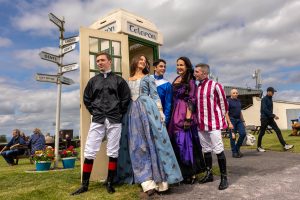
Jockeys Colin Keane, Ronan Whelan and Gary Carroll with models Estelle Geoghegan and Emma Maher
Mandatory Credit ©INPHO/Morgan Treacy
Day two, Wednesday August 26th will focus on junior racegoers and their families. Family day will be packed with free children’s entertainment such as bouncy castles, face painting, free ice cream for the first 100 children and a special 300th anniversary treasure hunt around the racecourse.
Over the two days displays celebrating 300 years of racing at Bellewstown will be located around the racecourse along with historical storytelling and memorabilia. Racegoers will get a true feel for the thrill of the hill while learning all about the legendary characters and events that shaped this iconic racecourse since 1726. Jack Gogarty, Bellewstown Racecourse Chairman, said:
“As Bellewstown Racecourse celebrates its 300th anniversary, we are not only celebrating our rich history but also looking forward to an exciting future and the 1726 restaurant and weigh room extension are just two examples of our ongoing investment in the racecourse’s future. We have lots of activities and events planned over the two days for racegoers to enjoy and mark this special occasion for Bellewstown Racecourse and the wider
community.“The Irish National Professional Bookmakers Association (INPBA) are kindly sponsoring the gate for our celebration event on Tuesday, August 25. To receive your free ticket, we ask everyone to pre-register on our website www.bellewstownraces.ie. We are looking forward to a very special two days.”
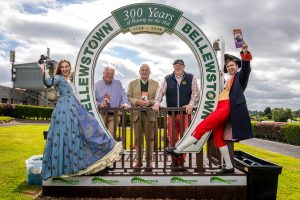
Vincent Murray, Director Bellewstown Racecourse Committee, Jack Gogarty, Chairman Bellewstown Racecourse Committee and Alan Delany, Vice Chairman Chairman Bellewstown Racecourse Committee
Mandatory Credit ©INPHO/Morgan Treacy
NOTES TO EDITOR
Economic and social benefits of horse racing and breeding in County Meath
The horse racing and breeding industry is a cornerstone of County Meath’s economy and culture.
With 427 registered thoroughbred breeders, 50 licenced racehorse trainers and four racecourses (Bellewstown, Fairyhouse, Laytown and Navan) the indigenous thoroughbred racing and breeding sector in County Meath generates over €215 million in annual expenditure and supports more than 3,300 direct and indirect local jobs. The industry is deeply embedded in the county’s cultural fabric, serving as a powerful driver of community cohesion, rural employment, and international prestige.
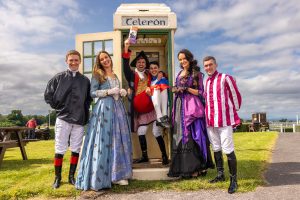
Jockeys Gary Carroll, Ronan Whelan and Colin Keane with models Estelle Geoghegan and Emma Maher
Mandatory Credit ©INPHO/Morgan Treacy
Bellewstown Racecourse timeline
1726: First Recorded Meeting
The earliest record of racing at Bellewstown appears in the Dublin Gazette and Weekly
Courier in August 1726. This marks the beginning of its long-standing tradition as one of Ireland’s most historic racecourses.
1766: Expansion to five-day meeting
By the mid-18th century, Bellewstown’s popularity soared. Meetings were extended to five days, with detailed race results recorded for the August festival in 1766.
1803: Royal recognition George Tandy, former Mayor of Drogheda, persuaded King George III to sponsor a race at Bellewstown. The event, called His Majesty’s Plate, was valued at £100 and became a prestigious feature of the festival.
1812: Turf Club allocation
The Irish Turf Club formalised the racing calendar, granting Bellewstown the last full week in June for its annual meeting.
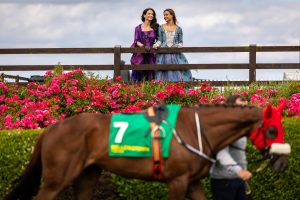
with models Estelle Geoghegan and Emma Maher Mandatory Credit ©INPHO/Morgan Treacy
1835 Journal: A glimpse into racing culture
While Bellewstown’s earliest records date back to 1726, historical accounts mention that journals and newspapers from the early 19th century documented the social and sporting life around the racecourse. The 1835 journal is often cited as part of these archival sources, offering insights into: Race meetings and social gatherings: The journal described Bellewstown as more than a racing venue—it was a social hub where local gentry, traders, and farmers mingled during the summer festivals. These events combined horse racing with music, dancing, and market fairs, reflecting the vibrant rural culture of the time.
Fashion and festivities: Reports highlighted the colourful attire of attendees and the festive atmosphere, with references to open-air banquets, travelling entertainers, and betting rings that were central to the experience.
Economic impact: The journal noted how race weeks boosted local trade, with inns and taverns overflowing and temporary stalls selling food, drink, and crafts. Although the original 1835 journal is not widely digitised, its content has been referenced in historical compilations such as 300 Years of Racing at Bellewstown and local heritage research.
1835: Lord Lieutenant’s visit
Historical accounts note that the Lord Lieutenant of Ireland attended the Bellewstown races in 1835, underscoring the event’s prestige during the 19th century.
His presence reflected Bellewstown’s status as a major social and sporting occasion, attracting aristocracy and influential figures.
The visit coincided with the vibrant festival atmosphere described in journals of the time, featuring racing, music, and rural fairs.
1843: Daniel O’Connell at Bellewstown
Daniel O’Connell, known as The Liberator, attended the Bellewstown races in 1843 during the height of his campaign for Repeal of the Union.
His presence added political significance to the event, blending Ireland’s racing tradition with its nationalist movement.
O’Connell’s visit reflected Bellewstown’s role as a social and cultural gathering point, attracting not only sporting enthusiasts but also influential figures in Irish history. An estimated 50,000 people attended the event.
1843 – The great repeal demonstration
Bellewstown Racecourse hosted one of the significant gatherings during Daniel O’Connell’s campaign for the Repeal of the Union.
Thousands attended this demonstration, blending Ireland’s political movement with its social and sporting traditions.
The event highlighted Bellewstown’s role as a cultural and political meeting point, not just a racing venue.
1844, June 26th – first race sponsorship
Dublin and Drogheda railway line added 25 sovereigns to a handicap sweepstakes of five sovereigns.
1859 – Current course established
Racing moved to its present location on the Hill of Crockafotha in February 1859, offering panoramic views of the Mourne Mountains and the Irish Sea.
1868 – Opening of the Gormanstown Stand
The Gormanstown Stand was inaugurated at Bellewstown Racecourse in 1868, marking a significant milestone in the venue’s development. This stand was named after the nearby Gormanstown railway station, which had become a key transport link for racegoers traveling from Dublin and Drogheda.
The stand provided covered seating and improved viewing facilities, elevating Bellewstown’s status as a premier rural racecourse.
Its construction coincided with the Victorian era’s emphasis on comfort and social prestige at sporting events, attracting a more diverse audience.
The proximity to Gormanstown station made Bellewstown more accessible, encouraging larger crowds and cementing its reputation as a summer racing
destination. The Gormanstown Stand symbolised Bellewstown’s transition from a rustic fairground- style venue to a more structured and modern racecourse, setting the stage for future expansions and festivals.
1873 – Start of steeplechasing at Bellewstown
Bellewstown introduced steeplechase racing in 1873, expanding its programme beyond flat racing.
This addition reflected the growing popularity of jump racing in Ireland during the late 19th century.
Steeplechasing continued at Bellewstown until 1977, when it was discontinued in favour of flat and hurdle racing.
Dublin and Drogheda railway line agreed to transport horses for free to and from the races. Bellewstown was the first track in Ireland to be afforded this benefit.
1975 – The Yellow Sam betting coup
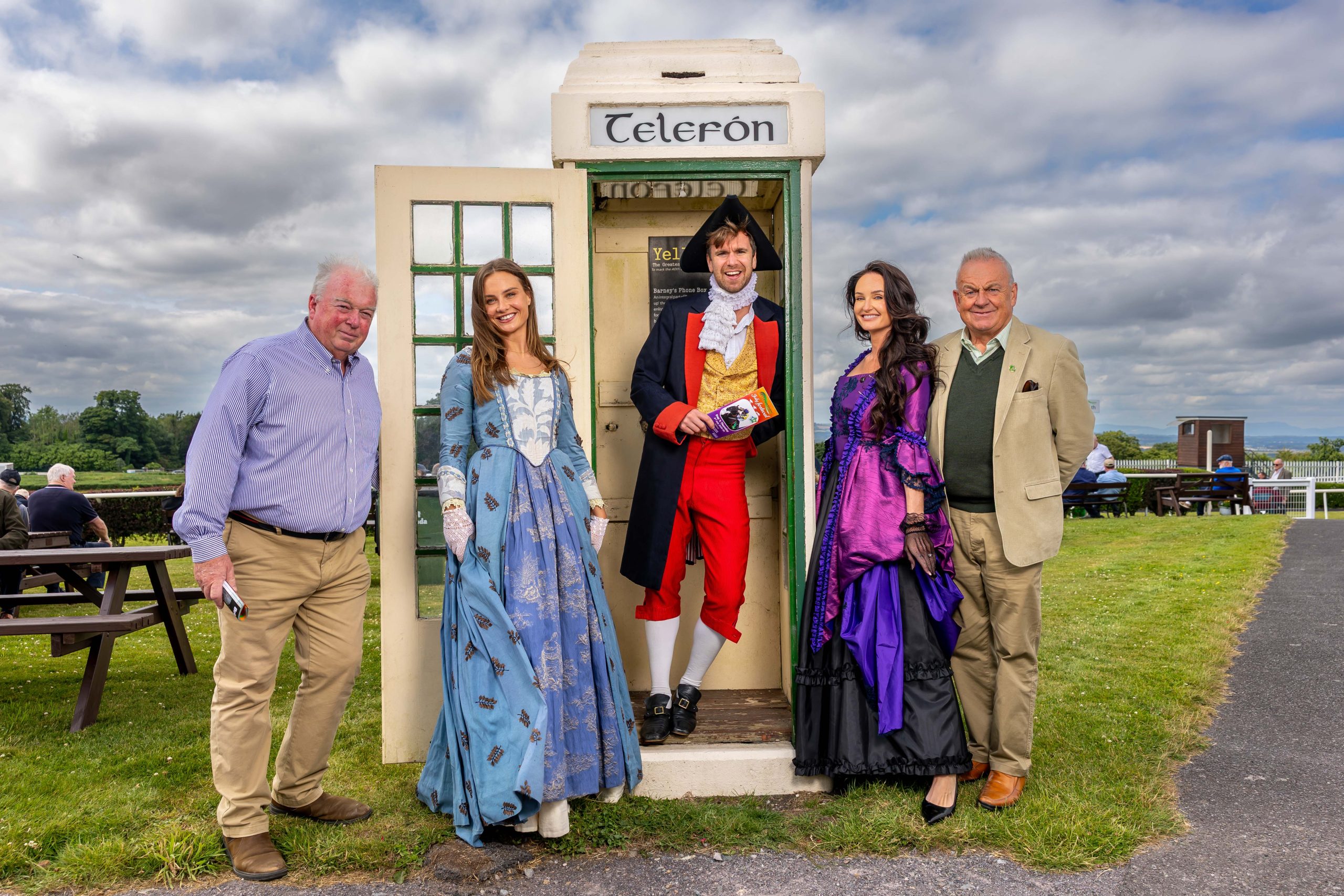
Bellewstown became famous for the legendary Yellow Sam betting coup, one of the most audacious gambles in racing history, executed on 26 June 1975 by Barney Curley, a legendary figure in Irish racing. Curley identified a horse named Yellow Sam, which had shown poor form on heavy
ground but was expected to excel on firm conditions. He planned to exploit Bellewstown’s limited communication infrastructure—at the time, the course had only one public telephone line connecting to betting offices. Curley’s team placed small bets across Ireland in the morning to avoid suspicion, then
launched a massive betting surge just before the race. Meanwhile, an accomplice occupied the only phone box at Bellewstown, pretending to make a long-distance call, preventing bookmakers from adjusting odds in time. Yellow Sam won at 20-1 odds, and Curley’s syndicate reportedly netted over
IR£300,000 (equivalent to millions today). The coup exposed vulnerabilities in the betting system and became a legendary tale of planning, secrecy, and nerve. This coup was voted the best gamble of all time by the Racing Post readers for its simplicity, creativity and ingenuity. The event cemented Curley’s reputation as a master strategist. It’s still regarded as one of the most daring and successful betting coups in racing history. Bellewstown commemorates this story through the Barney Curley Memorial Race and the DAFA Apprentice Series, continuing his charitable legacy.
2011 – Lester Piggott at Bellewstown Legendary jockey Lester Piggott attended Bellewstown for the Arkle Legends Race, supporting the Arkle Memorial Statue Fund.
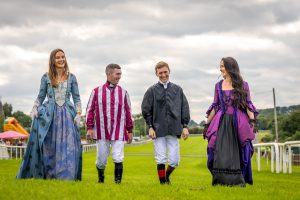
Jockeys Gary Carroll and Colin Keane with models Estelle Geoghegan and Emma Maher
Mandatory Credit ©INPHO/Morgan Treacy
2019 – Permanent stabling Investment Bellewstown signed off on a €532,000 development project, which included a €212,000 grant from Horse Racing Ireland, to build 100 permanent stables, a veterinary unit and stable staff cafeteria. This was a significant step forward for Bellewstown, ensuring permanent top-class facilities for horses, stable staff, and officials.
2020 – Completion of stable yard
The new stable block was completed just before the July Festival in 2020, marking a milestone in Bellewstown’s infrastructure. The yard now accommodates 110 runners per day, meeting the Irish Horseracing Regulatory Board’s (IHRB) health and safety standards.
This upgrade transformed Bellewstown from a one-day meeting venue into a six-day festival track, with plans for further expansion.
2021 – Frankie Dettori visits Bellewstown
Frankie Dettori visited Bellewstown for the first time, winning the Barney Curley Memorial Race aboard Trueba. The event raised €150,000 over two years for Curley’s charity, Direct Aid For Africa (DAFA). Dettori described Curley as a father figure and trusted mentor.
2024 – Barney Curley Apprentice Series
Ahead of the 50th anniversary of the Yellow Sam coup, Bellewstown launched the Barney Curley DAFA Apprentice Series, continuing his legacy of mentoring young jockeys.